Monday, June 20, 2011

Record Number of Threatened Birds spotted nesting in Collier County

Least Tern at Lake Jackson
Photo by Tim Ross
NAPLES – The Florida Department of Environmental Protection (DEP) and Florida Fish and Wildlife Conservation Commission (FWC) today announced a record number of least terns, a threatened species, nesting on an isolated sandbar near Marco Island in Collier County.


Each spring, migratory least terns (Sterna antillarum) scout local coastal areas and select a location that best meets the nesting needs of the colonial birds returning from wintering grounds in Central or South America. Over the past few years, tides and currents have been suitable for the re-formation of an emergent sandbar within DEP’s Rookery Bay National Estuarine Research Reserve. This sandbar, also known as “Second Chance,” now serves as habitat for the largest beach-nesting least tern colony in south Florida.

“At least 300 nests (with eggs) and about 100 more pairs with chicks are using the ‘Second Chance’ sandbar,” said FWC regional biologist Ricardo Zambrano. “About 800 birds (400 breeding pairs) is roughly the same number of birds that had used the sandbar the last time it was this large, nearly a decade ago."

Least terns lay their well-camouflaged eggs directly on the sand, and young are mobile within a few hours of hatching. Parent birds are the eggs’ and young’s only protection against the elements and predators.

A few acres in size, the elevated sandbar is located at the western edge of the Ten Thousand Islands. It has low vegetation to provide some shade for chicks and is free of land-based predators. The sand bar is monitored weekly by Reserve staff and volunteers and staff has posted with signs and string alerting boaters of the birds’ presence.

“The sandbar provides ideal nesting conditions for least terns,” said Gary Lytton, Rookery Bay Reserve manager. “Acting like a magnet, it is attracting birds from other locations and providing the greatest chance for nesting success in the region.”

Because it is isolated from the mainland the sandbar receives minimal human disturbance, which is crucial for the success of this species. Nesting least terns are easily disturbed by people (on foot or aboard approaching vessels) as well as dogs and other animals that may be perceived as predators. Boaters, anglers and wildlife enthusiasts are urged to avoid accessing, or even approaching, this important habitat until nesting season comes to a close, around mid-August.

Whenever you visit the beach, and especially during summer nesting season, do your part to share the shore with wildlife:

o Keep your distance from resting birds
o Use a high-powered spotting scope to get the best view from a reasonable distance
o Do not force birds to fly
o Respect posted areas
o Keep pets on a leash, on your boat, or leave them at home
o Don’t leave any litter behind
o Never deploy fireworks at or near an active nesting beach

Designated over 30 years ago, DEP’s Rookery Bay National Estuarine Research Reserve is located in Naples on the Southwest coast of Florida. The Reserve manages 110,000 acres and is engaged in education, research, training, and stewardship. The Environmental Learning Center serves as a regional education, research and training center with a 150-seat auditorium, classrooms, research labs and state-of-the-art visitor center with aquaria and interactive exhibits. For more information on Reserve, visit http://www.dep.state.fl.us/coastal/sites/rookery/.

Sunday, June 19, 2011

Reminders of War at Torreya State Park - Liberty County, Florida

Civil War Earthworks at Torreya State Park
Torreya State Park, located on the Apalachicola River in Liberty County, is best known for its stunning natural scenery and extremely rare trees and plants, but for those interested in Florida's Civil War history, it also holds a hidden treasure.

Located along the trail that leads down the slope from the beautifully restored antebellum Gregory House in the park can be found the earthwork remains of a Confederate fortification. Built to defend the river against invasion attempts by the Union Navy, the battery was one of a series of such fortifications along the river. It is, however, by far the best preserved.

150 years ago the Apalachicola River was a vital avenue of transportation. Paddlewheel steamboats churned up and down the river from Apalachicola, carrying cargo and people as far upriver as the cities of Columbus and Albany,Georgia, located far up its tributaries, the Chattahoochee and Flint Rivers.  Apalachicola at the beginning of the Civil War was one of the most important port cities on the Gulf Coast and the river itself provided access to some of the most successful plantations and farms in the South.

Gun Emplacement at Torreya State Park
When Apalachicola was evacuated by the Confederates in 1862, army engineers began to design a series of fortifications to stop Union warships from coming up the river to devastate inland cities and farming districts.

The battery at Torreya State Park once mounted an array of heavy guns and featured artillery emplacements, rifle pits and heavily reinforced magazines. Despite (and possibly because of) the reclamation of the site by the forest in the years after the Civil War, the earthworks remain in remarkable condition today and provide a rare opportunity to step back in time to the days when Florida desperately tried to defend itself from Northern invasion.

To learn more, please visit www.exploresouthernhistory.com/torreyabattery.

Tuesday, February 15, 2011

Kingsley Plantation - Fort George Island, Florida

Kingsley Plantation House
This is part two of a Black History Month series on key African American heritage sites in Florida

 Hidden on coastal island almost within site of the skyline of Jacksonville, the historic Kingsley Plantation holds tremendous significance in American History.

With a main house that was built using slave labor in 1798, the plantation was established during the days of when Florida was still a Spanish colony. In 1814 it was purchased by Zephania Kingsley and his African wife, Anta (Anna) Madgigine Jai. He had first come to Florida in 1803 and purchased her as a slave in Cuba in 1806. The two fell in love, however, and Kingsley set Anta and her children free in 1811. They were married and Zephaniah Kingsley, even though he continued to own slaves, became a major proponent for the rights of free blacks in America.

Florida was transferred from Spain to the United States in 1821 and the Kingsleys found themselves facing major changes in the laws affecting African Americans. Restriction after restriction was handed down and Zephaniah railed against these and debated lawmakers on the subject of the rights of free blacks. He also wrote a major treatise on the subject that was read and discussed both North and South.

By 1830, however, Kingsley realized he was fighting a lost cause. Deciding that there was no immediate hope of changing laws in the United States, he freed 50 of his slaves and took them to Haiti where he established a free settlement. He died in 1843, but Anta (Anna) lived until the 1870s and eventually returned to Florida to live out her days.

To learn more about their fascinating home and its many unique features, please visit www.exploresouthernhistory.com/kingsley.

Saturday, February 5, 2011

Events at Pensacola - The Accounts of Mrs. Slemmer & Mrs. Gilmer

Mrs. Caroline Slemmer
When state forces from Florida and Alabama had occupied Fort Barrancas, Fort McRee and the Pensacola Navy Yard in January of 1861, a number of the wives and children of soldiers were present. These, along with U.S. servicemen taken prisoner and paroled and other noncombatants, went aboard the storeship U.S.S. Supply. The vessel made its way out of Pensacola Harbor and set sail, arriving in New York 150 years ago today.

Aboard the Supply were the wives of Lieutenants Adam J. Slemmer and J.H. Gilman, the two principal officers now commanding the besieged garrison of fewer than 100 U.S. soldiers and sailors at Fort Pickens. They provided to northern newspapers a unique account of the situation at Pensacola as it had been when they left the harbor in January:

Statements of Mrs. Slemmer and Mrs. Gilman.

Mrs. Lieutenant Slemmer and Mrs. Lieut. J.H. Gilman, two ladies who have arrived at New York in the Supply, from Pensacola, have furnished the Times with some particulars attending their departure from that place. We quote:

The exodus from the Barrancas Fort was made necessarily in much haste, there being little time except to hurriedly pack up the most valuable articles of furniture and wardrobe. No personal violence was offered to three retreating women and children, but the sudden and peaceable breaking up of so many peaceful households, and the violent separation of family ties, were cause of great distress. To many the parting of husband and wife was as if for the last time, and tears bedewed many a hardy cheek when the last “good-bye” was spoken.

Fort Barrancas
During the day and night of the evacuation of Barrancas, and the transfer of the garrison to Fort Pickens, every person – men, the officers and their wives – performed prodigies of labor, and never obtained a wink of sleep for nearly twenty-four hours; and the hard work fell about equally upon all, without regard to rank or sex. The ladies cheerfully performed their part throughout the trying ordeal. On the day following the embarkation of the families on board the Supply, Mrs. Gilman and Mrs. Slemmer, accompanied by officers from the storeship, went on shore under a flag of truce to obtain a last interview with their husbands.

Lieut. Slemmer asserted that he could hold the place against five thousand men, and declared he would do it.

All the prisoners in the navy-yard were permitted to leave after giving their parole, and those who could get away left. Such as decided to remain were compelled to take the oath of allegiance to serve the State of Florida.

The United States steamer Wyandotte is kept constantly under steam, at a safe distance from the reach of enemies, and in readiness to co-operate in the defense of the fort. In case of an emergency she will be at hand ready to receive on board the garrison, should they be overpowered and obliged to abandon the fort to the enemy. There are arrangements by which the entire forces will be able to escape through a covered way to the beach, where they can take the boats and go on board any vessel that may be in waiting to receive them. In such event it will probably be blown up.

It is stated that every one of the lieutenants and most of the other officers on board the Wyandotte have resigned, and that with the exception of the engineers, Capt. Berryman has been left entirely alone. - Pittsfield Sun, February 6, 1861.

To learn more about the historic sites in and around Pensacola Bay, please visit www.exploresouthernhistory.com/pensacola1.
 

Friday, February 4, 2011

Black History Month in Florida - Fort Mose Historic State Park

Fort Mose Historic State Park
This is part one of a Black History Month series on key African American heritage sites in Florida.

Fort Mose Historic State Park

Visitors to historic St. Augustine often overlook Fort Mose, which is the focal point of a historic state park on the north side of the city. The park does not offer the towering stone walls of the Castillo de San Marcos or charming streets of America's oldest city, yet it is a historic site of enormous national importance.

Established in 1738 by the Spanish to serve as a first line of defense for the colonial city of St. Augustine, Fort Mose holds distinction as the first settlement ever established for free blacks in the continental United States.

Artist's Conception of Fort Mose
Designated as a National Historic Landmark, the fort was initially occupied by 100 free African Americans, many of whom had escaped from slavery in the Carolinas. The Spanish in Florida, however, offered them freedom if they would adopt the Catholic faith and join the local militia. The policy brought so many escaped slaves across the line into Florida that Fort Mose was established to give them a place to build homes and clear fields of their own. The settlement grew to become a significant part of the St. Augustine landscape.

The fort was the scene of an important battle during the English invasion of 1740, but was rebuilt and provided a home survived as a key settlement for free African Americans until 1763, when Spain surrendered Florida to England at the end of the Seven Years War. The inhabitants of the Fort Mose settlement were evacuated to Cuba, where their descendants live today.

It is truly sad to note that the Florida Department of Environmental Protection (DEP) now proposes closing Fort Mose, a site of great historical importance and a landmark of black history, to save money. The DEP is recommending that 56 Florida State Parks be closed to save $6.5 million (out of a total DEP budget of over $1.4 BILLION). Among them are many, like Fort Mose, that are significant to Florida's African American heritage. To voice your opinions on this, please click here to email Rep. Trudi K. Williams, who chairs the subcommittee considering the closure recommendation.

To learn more about Fort Mose, please visit www.exploresouthernhistory.com/fortmose2.

The park is hosting a special "Flight to Freedom" event to celebrate Black History Month on Saturday, February 12th. Cost of admission is $2 per person and reenactors will recreate life at the settlement with events including drumming demonstrations, cannon fire and more.

Monday, January 10, 2011

Tarpon Springs, Florida - Florida's Historic Sponge Port

Tarpon Springs, Florida
Located on the Gulf Coast of Florida just north of St. Petersburg, Tarpon Springs is a charming and picturesque community with a unique history and culture.

Incorporated in 1887 when the Orange Belt Railroad arrived, the community was named because early settlers observed large tarpon fish playing in local waters. The town quickly became a well-planned boom community thanks to wealthy Northerners who built winter homes there. It boomed even more when natural sponge fisheries were discovered offshore.

Tarpon Springs, Florida
A local businessman opened the Anclote River and Rock Island Sponge Company in 1890 and in less than 20 years Tarpon Springs became the center of the U.S. sponge industry. Divers and their families were brought in from the Greek Isles to work the sponge fisheries and the city became the largest sponge port in the United States.

Sponge fishing continues to this day in the waters off Tarpon Springs, although the industry was all but destroyed by a Red Tide in 1948. It has slowly rebounded over the years, however, and now brings about $2 million per year into the local economy. The real economy of Tarpon Springs is now based on tourism, which brings in more than $20 million a year. Visitors flock to the community to enjoy the beautiful scenery and rich Greek culture which is still quite evident today.

To learn more, please visit www.exploresouthernhistory.com/tarponsprings.

Monday, December 13, 2010

Chapman Botanical Gardens - Apalachicola, Florida

Chapman Botanical Garden
A beautiful memorial to one of Florida's best known botanists, the Chapman Botanical Garden is a beautiful landmark of Apalachicola, Florida.

Dr. Alvin W. Chapman, for whom the gardens are named, came to Florida in 1834 and lived in both Marianna and Quincy before moving to Apalachicola, where he lived out the rest of his life, in 1847. Trained as a physician, he fell in love with the botanical wonders of Florida and the South and devoted his life to exploration and discovery.

Dr. Alvin W. Chapman
Dr. Chapman is credited with discovering numerous species of rare plants in Florida, including Chapman's Rhododendron, the wild Florida azalea and others. He was a friend of Hardy Bryan Croom, who discovered the Florida Torreya, and was the author of a landmark volume on the plants of the South.

Dr. Chapman was also an important figure of the Civil War in Florida. A devoted Unionist, he remained in Apalachicola although his wife relocated to Marianna after Confederate troops withdrew from the city. He is mentioned often in the records of the Union blockade ships that were stationed offshore. Local legend also holds that he sometimes hid in Trinity Episcopal Church when occasional Confederate patrols entered the city.

The Chapman Botanical Garden, located adjacent to Orman House Historic State Park and the Three Soldiers Monument on Market Street in Apalachicola, features winding paths, footbridges, butterfly gardens, unique plantings and much more. The garden is one of the most beautiful in any small city in the South and is well worth a visit.

To learn more and see additional photos, please visit www.exploresouthernhistory.com/chapmangarden.

Sunday, October 24, 2010

Devil's Millhopper Geological State Park - Gainesville, Florida

On the northern outskirts of Gainesville, the Devil's Millhopper Geological State Park offers the opportunity to descend to an exotic natural environment that thrives more than 120 feet below the normal surface of Florida.

The Devil's Millhopper is the somewhat sinister name given to a massive sinkhole. Created by water that eroded the karst or limestone that prevails beneath much of Florida until finally the surface collapsed to form a huge hole, the Millhopper is roughly 500 feet across from rim to rim and 120 feet deep. Put into perspective, the Statue of Liberty could be placed in the sinkhole and only the arm holding the torch would appear above ground.

There are many stories surrounding the origin of the use of the name Devil's Millhopper. The most common is that it takes the shape of the interior of a hopper from an old gristmill. Early explorers found many bones of animals in the bottom and easily created the legend that it was a gateway to the Devil and Hell.

While it is in no way a sinister place, it is a fascinating geological landmark that is well worth the short drive off I-75 at Gainesville. To learn more and see additional pictures, please visit www.exploresouthernhistory.com/devilsmillhopper.

Friday, August 20, 2010

Warden Castle (Ripley's Believe It or Not!) - St. Augustine, Florida

The original Ripley's Believe It or Not! Museum(R) in St. Augustine, Florida, is a landmark in and of itself. The unique chain of quirky and fun museums spread out from here. But the one in St. Augustine is even more special because of its location, the beautifully designed and supposedly haunted Warden Castle.

During the years after the Civil War, many of the nation's wealthiest families looked to the Southern coast as locations for winter homes. It was during this era that the Millionaire Village grew on Jekyll Island, Georgia. Just down the coast, the historic old city of St. Augustine also attracted the attention of some the country' 19th century rich and famous.

Among these was William G. Warden, a business partner of John D. Rockefeller. Adopting St. Augustine as his winter home, Warden built the Warden Castle there in 1887. Massive in scale and designed in a unique Moorish Revival Style, the huge home hosted many of the nation's most elite business leaders and their families during winter visits to St. Augustine. It remained in the hands of the Warden family until the 1930s.

Warden Castle later became a hotel and was even one of the homes of famed novelist Marjorie Kinnan Rawlings. It is also the focus of a number of St. Augustine's best known ghost stories.

To learn more about the unique and historic structure, please visit www.exploresouthernhistory.com/staugustineripley.

Thursday, July 29, 2010

Mission Nombre de Dios - St. Augustine, Florida

It has because been called "the most sacred acre in America" and Mission Nombre de Dios in St. Augustine has truly earned that honor.

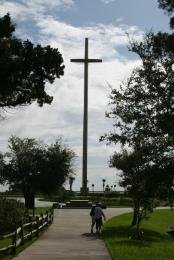
Now a beautiful park setting with a magnificent steel cross facing Matanzas Bay, the restored Chapel of Nuestra Senora de La Leche, historic cemetery and interpretive signs detailing the history of the site, the mission commemorates the planting of the first permanent Christian church in the United States.

On September 8, 1565, a Spanish flotilla commanded by Pedro Menendez de Aviles arrived in Florida's Matanzas Bay. He had been ordered to drive away the French who had built Fort Caroline on the St. Johns River and to plant a permanent settlement that would firmly establish Spain's title to the region. Spotting the Timucuan town of Seloy, Menendez came ashore and quickly established friendly relations with the leaders and inhabitants of the town.

On the same day, the fleet chaplain conducted a Mass of Thanksgiving to thank God for the safe arrival of the settlers in the New World. The Mass marked the firm establishment of the Catholic Church at St. Augustine and its presence has continued there without interruption for nearly 450 years.

Over the years that followed, Mission Nombre de Dios and its Chapel of Nuestra Senora de La Leche served as the mother of a chain of missions that stretched across Florida and up the East Coast as far as Virginia. The stone chapel was bombarded and destroyed by the Spanish themselves to prevent its use by English attackers during the 1700s, but was restored in 1875.

Today the site is open to the public daily and is a major landmark in the history of Christianity in the United States. Please click here to learn more about Mission Nombre de Dios: www.exploresouthernhistory.com/nombrededios.

Friday, July 16, 2010

Greenwood, Florida - Antebellum Community in the Panhandle

Founded in 1824 and settled even earlier, the town of Greenwood is a very special Florida community. It boasts an outstanding collection of antebellum homes and is a place where visitors can walk along the sidewalks and enjoy Southern hospitality at its finest beneath the shady oaks of the Sunshine State.

Established largely by residents who moved down from Georgia and the Carolinas to build plantations on the rich lands of central Jackson County, Greenwood was located at a strategic intersection where two important east-west roads crossed. It provided a likely spot for a trading community and as the surrounding farms grew more prosperous, so did the town that provided the planters with supplies, churches, a school and legal and medical services.

By the time of the War Between the States (or Civil War), Greenwood was a thriving little center of commerce and political strength. Many of the planters of the area had built "town" homes there, leaving the day to day operations on their plantations to their overseers. A number of these homes still stand.

Among the best known are the Erwin House (ca. 1830), the Hayes Long Mansion (1840) and Great Oaks (1860). None of the town's homes are open to the public, but historical markers stand in front of many and visitors can walk along the sidewalks of Greenwood to take pictures and enjoy the views.

The Methodist and Baptist cemeteries both date back to before the Civil War and buried in both are key figures not only from the founding days of the town, but also from Florida's early political era and the Confederate and U.S. military service.

To learn more about historic Greenwood, please visit www.exploresouthernhistory.com/greenwood.

Sunday, June 27, 2010

Crystal River Archaeological State Park - Crystal River, Florida

Preserving a group of ancient Indian mounds, the Crystal River Archaeological State Park home to one of the most significant archaeological sites in the United States.

The site was occupied for a span of more than 2,000 years and the first burial mound was built several hundred years before the birth of Christ. Over the centuries that followed, the inhabitants developed their town into a major ceremonial center.

Researchers believe that the mounds and mysterious stone stele or monuments found there were aligned to form a giant astronomical observatory, so that the inhabitants could time the passing of the seasons. Two of the unusual limestone stele can still be seen on the grounds. One of them bears the weathered carving of a human face.

The most stunning aspect of the park, however, is Mound A, a large platform mound overlooking the Crystal River. Wooden stairs lead up the side to the top, where visitors can take in a stunning view of the river and entire archaeological site. Sadly, even though what remains is impressive, only 1/4 or so of the original mound remains. The rest was carried away years ago and used as fill.

To learn more about the park, please visit www.exploresouthernhistory.com/crystalrivermounds.

Thursday, June 24, 2010

Yulee Sugar Mill Ruins Historic State Park - Homossassa, Florida

David Levy Yulee was one of the first great business leaders of the fledgling state of Florida. While little remains to commemorate the role of this industrious 19th century leader's role in the development of our state, the picturesque ruins of one of his enterprises have long attracted the attention of visitors to the Gulf Coast north of Tampa.

Yulee Sugar Mill Ruins Historic State Park in Homossassa preserves the surviving ruins of a sugar mill built by David Yulee on his 5,100 acre Margarita plantation.

The man who served as Florida's first U.S. senator when the former Spanish colony became a state in 1845 lived on a nearby island in the Homossassa River from which he could supervise his vast holdings. Sugar was then a major export product and the marshes and lowlying swamps along the rivers of Central and South Florida provided ideal for growing sugar cane.

The mill began operating in 1851, served by the labors of 69 slaves who planted and chopped the sugar cane, ran the stalks through the rollers of the cane press and then boiled the juice to make sugar. Packed into hogsheads (large barrels), the sugar was then placed aboard vessels in the Homossassa River for shipment to both American and foreign ports.

The mill operated until the Civil War, when the Union blockade brought the sugar export business to a temporary end. Yulee's house was burned by U.S. sailors, but the mill survived the war only to fall into disuse and eventually crumble into ruins.

To learn more, please visit www.exploresouthernhistory.com/yuleesugarmill.

Sunday, June 20, 2010

Blue Springs Recreational Area - Marianna, Florida

Because they were sources of cool, clear water, history often revolved around Florida's beautiful natural springs. Blue Springs near Marianna, for example, have a documented history dating back more than 300 years.

Archaeologically, the spring area was occupied even earlier than that. Early Native American hunters frequented the area around Blue Springs because it was a rich habitat for wildlife, fish and plants. The numerous caves in the vicinity have revealed evidence of having been used as campsites for early hunting parties.

The first written references to the spring date from the 1600s. Spanish missionaries passed what they called Calistoble or Calutoble Spring on their way to establish missions among the Chacato Indians (not to be confused with the Choctaw), who lived in western Jackson and eastern Washington and Holmes Counties. The missions lasted only for a year until the Franciscan friars were driven out in an uprising in 1675. The Spanish sent a military force into the area in 1676 to punish those responsible for the rebellion and to burn the homes and fields of the warring faction of the Chacato.

The spring was visited again in 1693 when it was a campsite on the overland journey of Governor-Designate Don Laureano de Torres de Ayala, who completed the first recorded crossing of the Florida Panhandle from the Apalachicola River to Pensacola Bay. Journals from that expedition describe the crystal clear water of the spring and buffalo grazing in the surrounding area.


In 1818, the spring was a stop on General Andrew Jackson's march from Fort Gadsden on the Apalachicola River to Pensacola. The First Seminole War was then underway, but Jackson's soldiers took time to marvel at the beautiful natural fountain that was by then called "Big Spring" in the account written by the army's topographer.

The first settlers arrived in the area just two years later and the spring became one of the early court sites for Jackson County. William Robinson operated a large plantation there, but in 1845 the property passed into the ownership of his nephew, John Milton, who renamed the farm "Sylvania" and gave the spring the name it bears today.

Milton served as Governor of Florida during the Civil War and a camp for Confederate cavalry was established at the spring. Civil War documents indicate it was occupied for three years.

Blue Springs is today the center of a beautiful recreational area operated by Jackson County. To learn more, please visit www.exploresouthernhistory.com/jacksonbluespring.

Sunday, April 4, 2010

Rainbow Springs State Park - Dunnellon, Florida

Although archaeologists believe that early Native American hunters camped around Rainbow Springs thousands of years before Christ, the beautiful Florida spring is perhaps best known for its more recent history.

A large first magnitude spring, Rainbow Springs is actually the fourth largest spring in Florida. It pours out 490 million gallons of water a day. A naturally beautiful and scenic spot, it was picked during the 1920s as the site for an early Florida amusement park. The park opened in the 1930s and operated for four decades before the new interstate highway system diverted traffic away from U.S. Highway 41 leading to a major reduction in visitors that led to the closing of the park. Before it closed, however, Rainbow Springs drew in hundreds of thousands of tourists who enjoyed such attractions as "submarine boats" and a leaf shaped monorail.

With development spreading rapidly in Florida, local residents ignited a drive to save the springs after the amusement park closed. Thanks to the vision of Florida's governor and cabinet, Rainbow Springs State Park opened its gates to the public in 1995. The park now preserves more than 1,400 of beautiful and historic land surrounding the head spring and the short but highly scenic Rainbow River.

To learn more about this stunning spring and a state park that may well be the best $2 attraction in the South, please visit www.exploresouthernhistory.com/rainbowsprings.