Showing posts with label paynes prairie. Show all posts

Friday, July 8, 2011

Paynes Prairie - The Lake that became a Prairie

Paynes Prairie
As drivers head south from Gainesville on I-75 or U.S. 441, they come down off a hill and pass over a wide and open expanse of grassland called Paynes Prairie. Because the prairie is so vast and flat, with a little imagine it is easy to conceive that this was once a heavily-traveled lake.

This area was left an uninhabited wilderness after the original Indian tribes were all but wiped out in the brutal English led raids on the Florida missions and villages during the early 1700s. By the middle of that century, the first small groups of Creeks began to drift down from what is now Alabama and Georgia. They found the prairie rich in wildlife and the surrounding lands good for farming. Others followed and before the time of the American Revolution, what would become the Alachua band of the Seminole Nation had begun to form.

The Alachua gave their name to today's Alachua County, Florida, and the prairie was originally called the Alachua Savannah as well. For many decades it appeared much as it does today, although with much more natural wildlife.  After the Civil War, however, this changed dramatically.
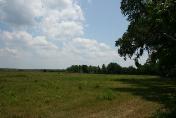
Paynes Prairie
Central Florida experienced several abnormally rainy years and the result was that the groundwater table rose and the vast basin of Paynes Prairie (the name comes from King Payne, an early 19th century Seminole chief) filled with water.

Between 1871 and 1873, Paynes Prairie became a huge lake. And even when the rainy years ended, the lake remained. Steamboats and other vessels navigated its waters, carrying passengers and cargo. It seemed that the landscape had been forever changed.

But then in 1891, the Alachua Sink in the bottom of the prairie reopened and almost instantly the lake was gone! Its waters flowed away into underground passages and once again Paynes Prairie returned to being what it is today, a vast and beautiful grassland.

To learn more about this historic state preserve, please visit www.exploresouthernhistory.com/paynesprairie.

Sunday, March 15, 2009

The Face of Osceola - Florida's Great Seminole Warrior


This cast of the face of Osceola is among the displays that can be seen in the visitor center at Paynes Prairie Preserve State Park near Micanopy.

The cast was prepared from a "death mask" made of Osceola on the day he died at Fort Moultrie, South Carolina, and shows the real appearance of the famed Seminole warrior. It was made shortly after Osceola posed for the famous portrait by George Catlin (see below).


Born in the Upper Creek towns of Alabama in around 1804, Osceola's mother, Polly Coppinger, was a member of Peter McQueen's town. Disagreement continues today over whether his father was an English trader named William Powell or a Creek warrior that his mother married shortly after Powell's death. Either way, the young warrior was often called "Billy Powell" by the whites.

Osceola (a corruption of the Muskogee term Asi Yahola or "Black Drink Shouter") and his mother were among the followers of Peter McQueen that followed the chief to Florida following the defeat of the Red Stick faction during the Creek War of 1813-1814. He was likely present at Econfina Natural Bridge between the St. Marks and Suwannee Rivers during the spring of 1818 when the troops of Andrew Jackson attacked McQueen's band, killing dozens of warriors and taking scores of women and children prisoner.

The young Osceola, then about 14 years old, escaped the battle, however, and soon appeared among the Seminoles of the Ocala area. He went on to become a key leader during the Second Seminole War of 1835-1842, but was captured by U.S. troops when he approached an army camp near St. Augustine under a flag of truce on October 21, 1837.

Imprisoned first at the Castillo de San Marcos (Fort Marion) in St. Augustine and subsequently at Fort Moultrie in South Carolina, the great warrior did not long survive his captivity. He died at Fort Moultrie of fever, probably malaria, on January 30, 1838, just three months after he was taken prisoner.

The original death mask prepared at Fort Moultrie is now housed at the Smithsonian Institution in Washington, D.C., but a cast made using it can be seen along with other artifacts at Paynes Prairie, an outstanding state park and preserve in Micanopy (just south of Gainesville). To learn more, please visit www.exploresouthernhistory.com/paynesprairie.

Friday, March 13, 2009

Paynes Prairie Preserve State Park - Micanopy, Florida


One of the most amazing sights in Florida is the beautiful expanse of Paynes Prairie stretching off to the horizon. Located between Gainesville and Micanopy (Interstate 75 actually crosses part of the prairie), the magnificent grassland is now a state park that preserves over 21,000 acres.

Called the "Great Alachua Savannah" by William Bartram when he visited in 1774, the prairie is centered in the traditional home region of the Alachua division of the Seminole Nation. Likely named for the great Seminole leader King Payne, the prairie was the location of one of the first engagements of the Second Seminole War. Florida militia battled Seminole warriors in the Battle of Black Point along the prairie rim in 1835.

The visitor center at Paynes Prairie Preserve State Park offers an excellent walk through the history of the prairie and even features a cast of the actual face of Osceola, Florida's famed Seminole warrior. The cast was prepared from a desk mask made at the time of the leader's death.

In addition, if they are lucky, visitors can sometimes catch glimpses of the herd of buffalo that roams the preserve. Florida reintroduced American Bison (buffalo) to Paynes Prairie during the late 20th century. The prairie once teemed with them, but they vanished over the last several hundred years. Paynes Prairie is also home to a small herd of wild Spanish horses.

The park is located on U.S. 441 in Micanopy, Florida and is easily accessible off I-75. For more information, please visit www.exploresouthernhistory.com/paynesprairie.